Mekavelle
ELEVATE LAYOUT
ELEVATE LAYOUT
Couldn't load pickup availability
Self-paced learning overview
- 📥 Digital file available after purchase
- ♾️ Long-term availability
- 🔒 Secure checkout
- 🗓️ Content updated in 2026
1. Problem Statement
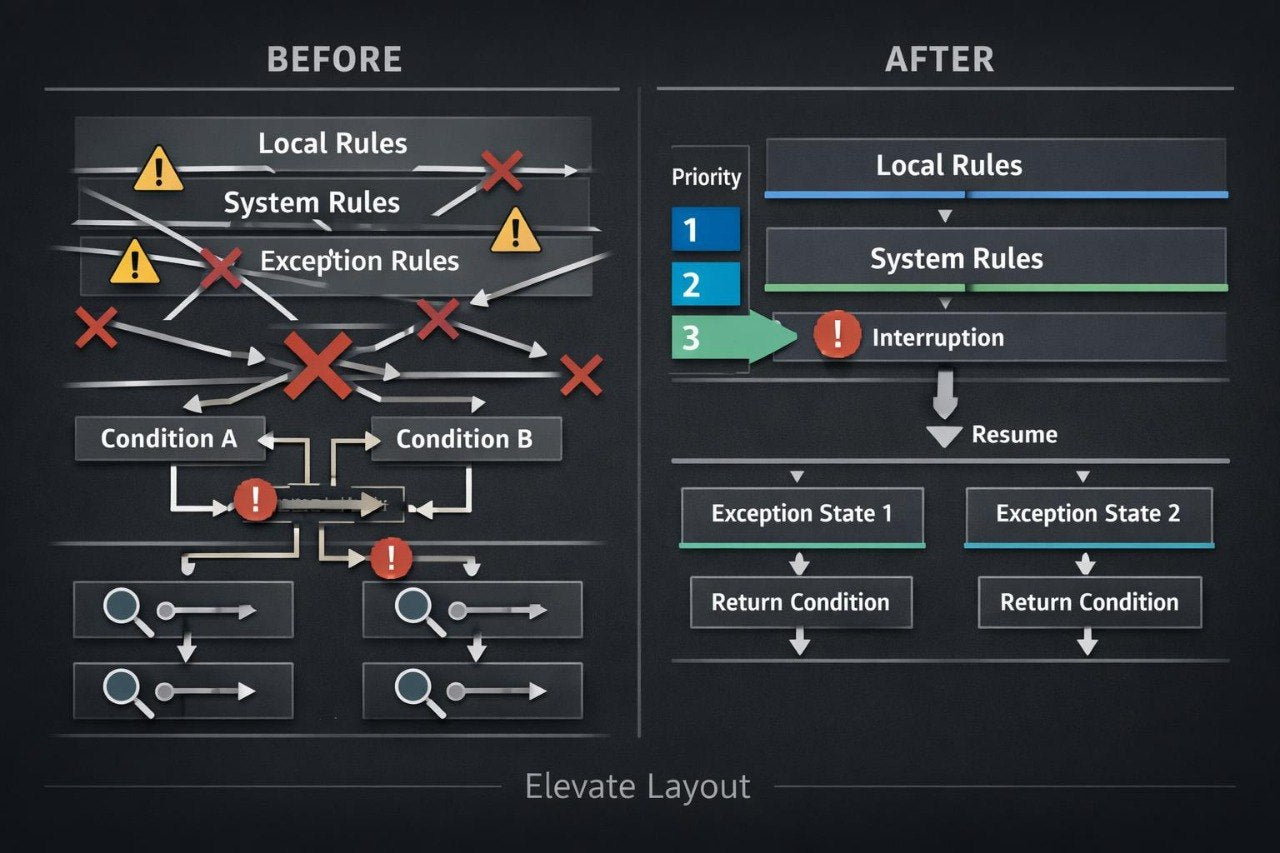
Struggling to manage a system in which several rules may activate at the same time? You’re not alone: as the number of mechanics grows, it becomes harder to determine which reaction should occur first. One rule may change a state required by another component, while a higher-priority event may interrupt an active sequence. Adding a new mechanic can also create hidden conflicts inside earlier scenarios. Without one approach to priorities, exceptions, and change review, the system may respond differently under similar conditions.
2. Solution
This course will teach you how to coordinate several logic systems within one architecture. You will explore priority levels, interruption rules, exception states, and methods for resolving conflicts. The materials demonstrate how to restructure detailed logic maps while preserving important dependencies. Practical assignments help you compare several possible reactions and define their execution order. By the end of the course, you will create a multi-layer model with clear coordination, interruption, and restoration rules.
3. What’s Inside
Module 1: Multi-Layer Logic Structures
Examine systems where local rules operate alongside wider scenario rules. This module helps define which layer is responsible for a particular action, state, or restriction.
Module 2: Priority Frameworks
Create a priority scale for events, checks, and reactions. The practical exercise asks you to assign at least fifteen rules to defined execution levels.
Module 3: Conflict Resolution
Study situations where two or more conditions provide different commands. You will document rules for selecting, delaying, or cancelling a reaction.
Module 4: Interrupt and Resume Logic
Explore how an active sequence can be interrupted and later resumed. A separate exercise covers scenarios where the system returns to an earlier stage while retaining recorded values.
Module 5: Exception States
Create rules for uncommon situations that do not belong to the main route. This module helps separate exceptions from standard logic and define return conditions.
Module 6: Logic Restructuring
Learn how to review detailed maps, locate duplicated rules, and combine repeated checks. The materials also explain how to document changes for later analysis.
Module 7: Elevate Layout Coordination Project
Create a system containing several rule layers, priorities, interruptions, and exception states. The final project includes an architecture map, a conflict table, and a collection of coordination-review scenarios.
4. Who Is This For?
✅ Suitable if you:
- have already created systems with several connected mechanics;
- want to work with rule priorities and conflicts;
- want to structure exception states;
- plan to restructure detailed logic maps;
- are prepared to examine complex interaction scenarios.
❌ Not for you if you:
- are beginning to study states, events, and conditions;
- need a brief introductory course;
- do not plan to work with multi-layer diagrams;
- expect materials linked to a named program;
- do not want to complete the final coordination project.
5. What You’ll Learn
After completing Elevate Layout, you will be able to:
- build a system containing at least three logic layers;
- assign priorities to fifteen or more rules;
- document at least eight conflict scenarios;
- create interruption and restoration rules;
- define five exception states;
- locate duplicated or conflicting checks;
- restructure a detailed map while preserving key dependencies;
- prepare at least eighteen review scenarios;
- document a complete game logic coordination model.
6. Refund Terms
A refund request for Elevate Layout may be submitted within 30 calendar days of the order date. Each request is reviewed according to the published store policy, the amount of material already completed, and the terms connected to the relevant order.
7. Certificate
Learners receive a digital Mekavelle certificate after completing the required modules, practical exercises, and final project. The certificate records completion of Elevate Layout: Complex Logic Coordination.
1. Which experience levels are Mekavelle courses created for?
1. Which experience levels are Mekavelle courses created for?
The courses are structured for different levels of prior experience. Each plan has its own material depth, number of modules, and practical assignments, allowing learners to select a format that matches their current knowledge and learning goals.
2. How are the learning materials organized?
2. How are the learning materials organized?
The materials are divided into sequential modules with explanations, diagrams, examples, exercises, and final assignments. This structure helps learners gradually explore rules, states, events, conditions, and interactions within game systems.
3. Can I study at my own pace?
3. Can I study at my own pace?
Yes. Learners can organize their own study schedule and return to previous topics when revision is needed. Completing the modules in order is recommended because later topics build on concepts introduced earlier.
4. Is a certificate included?
4. Is a certificate included?
A digital certificate is included with plans that contain a complete learning path. It is issued after the learner completes the required modules and final assignment listed in the relevant course outline.
Share