Mekavelle
FLOW NODE
FLOW NODE
Couldn't load pickup availability
Self-paced learning overview
- 📥 Digital file available after purchase
- ♾️ Long-term availability
- 🔒 Secure checkout
- 🗓️ Content updated in 2026
1. Problem Statement
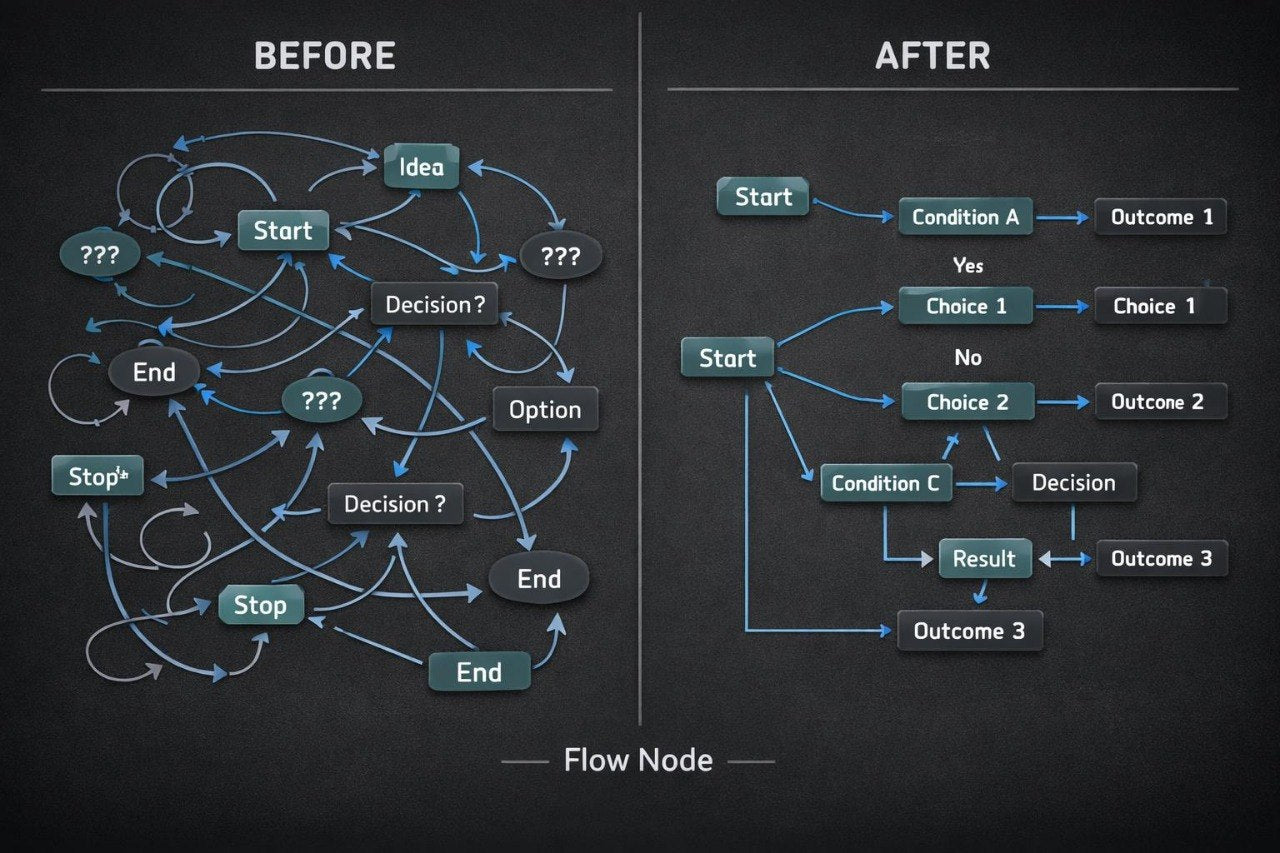
Struggling to build a game scenario with several paths while keeping every logical connection organized? You’re not alone: each new decision can introduce additional states, conditions, and reactions. When transitions are not mapped in advance, separate branches may duplicate one another or end without a defined outcome. Certain actions may also skip an important stage or activate an event in the wrong order. Without one complete scenario map, it becomes difficult to understand how a change to a single rule affects the wider system.
2. Solution
This course will teach you how to build logic networks with several connected paths. You will examine decision nodes, transition rules, event dependencies, and methods for merging branches. The materials demonstrate how to maintain a clear structure when a scenario contains many possible routes. Practical exercises help you review each route separately and compare its behavior with other paths. By the end of the course, you will prepare a branching logic map with defined starting points, transitions, and endings.
3. What’s Inside
Module 1: Logic Nodes and Connections
Learn how to represent rules, decisions, events, and outcomes as separate nodes. This module explains how to show the direction of each connection and distinguish required transitions from conditional ones.
Module 2: Branching Path Design
Build a scenario containing several possible developments. The practical assignment asks you to create at least four branches with different transition conditions.
Module 3: Decision Dependencies
Explore how an earlier decision can affect events that occur later. You will document dependencies and check whether each condition receives the information required for its evaluation.
Module 4: Merging Logic Paths
Study methods for bringing separate branches back into one shared route. Particular attention is given to situations where several paths reach the same state under different conditions.
Module 5: Priority and Sequence Rules
Define the order in which checks and reactions occur within a detailed scenario. The exercises help identify conflicts where two conditions may activate during the same sequence.
Module 6: Path Validation
Create a route-review table and examine whether each branch can move from its starting point to a defined ending. This module also covers missing transitions and repeated nodes.
Module 7: Flow Node Scenario Project
Create a logic network containing several decisions, merged paths, and different endings. The final project includes a node map, a condition table, and an explanation of the main scenarios.
4. Who Is This For?
✅ Suitable if you:
- understand the principles of states, conditions, and events;
- want to create branching scenarios;
- work with decisions that affect later system behavior;
- want to review every logical route;
- would like to organize larger interaction maps.
❌ Not for you if you:
- are only beginning to learn the basic terminology;
- need a course centered on a named program;
- do not plan to create diagrams and tables;
- expect a brief overview without a final assignment.
5. What You’ll Learn
After completing Flow Node, you will be able to:
- create a map containing at least twelve logic nodes;
- build four or more connected routes;
- document at least fifteen transition conditions;
- identify dependencies between earlier and later decisions;
- merge several branches into one shared state;
- define the order for reviewing conflicting conditions;
- prepare a route-validation table;
- locate a missing, duplicated, or unreachable node;
- produce a complete branching scenario map.
6. Refund Terms
A refund request for Flow Node may be submitted within 30 calendar days of the order date. Each request is reviewed according to the published store policy, the amount of material already completed, and the terms connected to the relevant order.
7. Certificate
Learners receive a digital Mekavelle certificate after completing the required modules, practical exercises, and final scenario project. The certificate records completion of Flow Node: Branching Logic Design.
1. Which experience levels are Mekavelle courses created for?
1. Which experience levels are Mekavelle courses created for?
The courses are structured for different levels of prior experience. Each plan has its own material depth, number of modules, and practical assignments, allowing learners to select a format that matches their current knowledge and learning goals.
2. How are the learning materials organized?
2. How are the learning materials organized?
The materials are divided into sequential modules with explanations, diagrams, examples, exercises, and final assignments. This structure helps learners gradually explore rules, states, events, conditions, and interactions within game systems.
3. Can I study at my own pace?
3. Can I study at my own pace?
Yes. Learners can organize their own study schedule and return to previous topics when revision is needed. Completing the modules in order is recommended because later topics build on concepts introduced earlier.
4. Is a certificate included?
4. Is a certificate included?
A digital certificate is included with plans that contain a complete learning path. It is issued after the learner completes the required modules and final assignment listed in the relevant course outline.
Share