Mekavelle
FREE KIT
FREE KIT
Couldn't load pickup availability
Self-paced learning overview
- 📥 Digital file available after purchase
- ♾️ Long-term availability
- 🔒 Secure checkout
- 🗓️ Content updated in 2026
1. Problem Statement
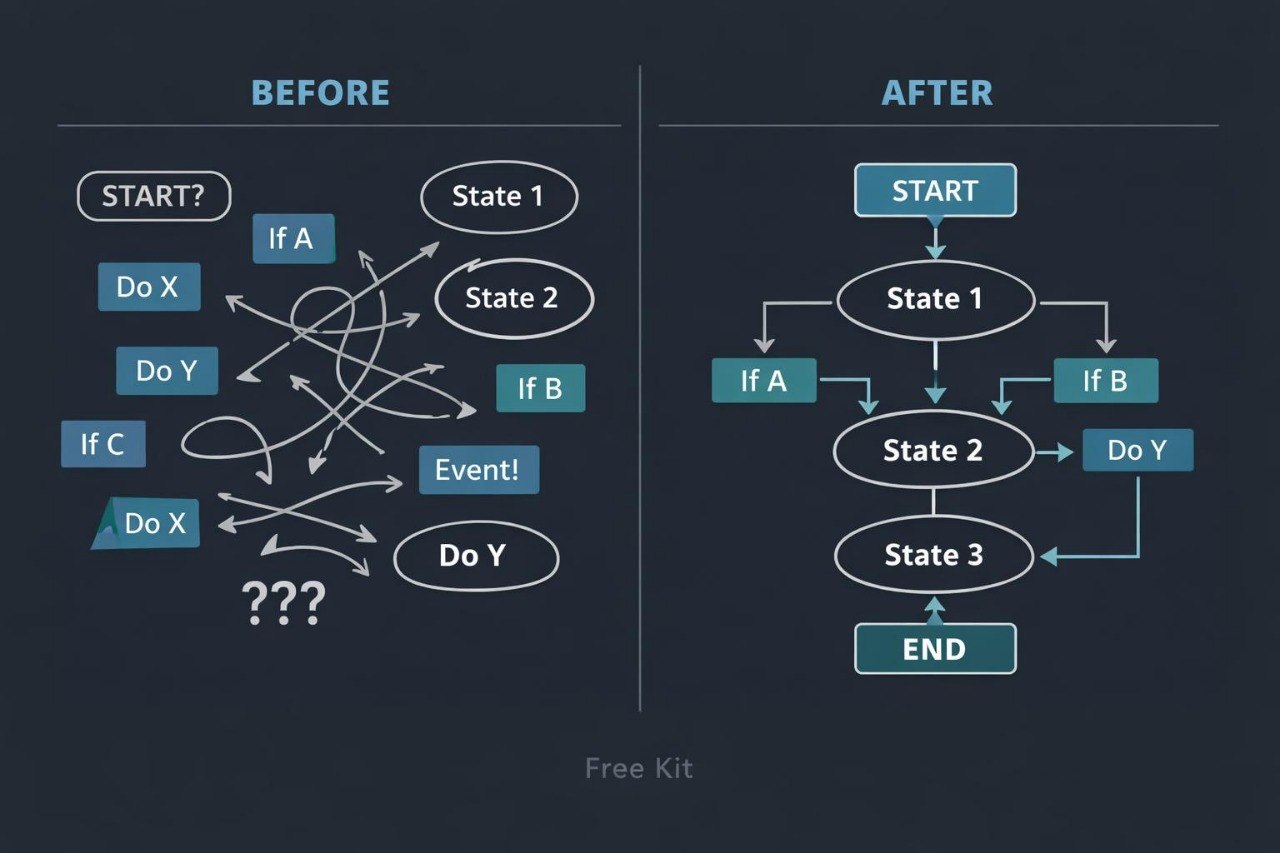
Struggling to understand why a game mechanic behaves differently from what you planned? You’re not alone: even a simple interaction can include several conditions, states, and events that influence one another. Without a clear structure, rules may conflict and the behavior of game elements can become difficult to examine. New learners may also find it difficult to decide which element should begin a logic sequence. As a result, a small idea can develop into a confusing system without a defined order of actions.
2. Solution
This course will teach you how to divide a game interaction into separate logical components. You will explore how to identify an initial state, define transition conditions, and describe how a system reacts to an event. The materials demonstrate how to build sequences in which every rule has a clear purpose. Practical exercises help you review logic through small scenarios before working with more detailed mechanics. By the end of the course, you will create your own diagram for a basic game system and explain how its elements work together.
3. What’s Inside
Module 1: The Building Blocks of Game Logic
Explore the main components of game logic: rules, conditions, states, events, actions, and outcomes. This module explains the difference between these elements and the role each one plays within a system.
Module 2: States and Transitions
Learn how to describe the current state of a game element and determine what must happen before it moves into another state. The practical assignment asks you to create a diagram containing at least three connected states.
Module 3: Conditions and Decisions
This module focuses on conditions, checks, and logical branches. You will work with scenarios in which system behavior changes according to a learner-defined action or an existing state.
Module 4: Events and Reactions
Explore how an event can activate one or several reactions. The examples demonstrate how event order affects an outcome and why the original cause should be separated from the action that follows.
Module 5: Your First Logic Map
The final module combines the previous topics into one structured diagram. You will create a small logic map containing an initial state, two branches, several conditions, and a defined scenario ending.
4. Who Is This For?
✅ Suitable if you:
- are beginning to explore Game Logic Development;
- want to understand the structure behind game rules;
- want to describe mechanics before building them;
- enjoy working with diagrams, scenarios, and cause-and-effect relationships;
- are looking for a focused introductory course with practical tasks.
❌ Not for you if you:
- need an in-depth course about complex interconnected systems;
- expect materials based on named programs or third-party platforms;
- already build detailed multi-state and event-based systems;
- do not plan to complete exercises or the final assignment.
5. What You’ll Learn
After completing Free Kit, you will be able to:
- distinguish between rules, states, conditions, events, and actions;
- create a diagram containing at least three states;
- write at least six conditions for a small scenario;
- build two logical branches;
- identify an initial event and its related reactions;
- locate a conflicting or missing rule in a simple diagram;
- prepare one complete game logic map;
- explain the operating sequence of the system you created.
6. Course Terms and Refunds
Free Kit is provided without a charge, so a refund does not apply to this plan. For paid Mekavelle plans, a refund request may be submitted within 30 calendar days in accordance with the published store policy and the terms connected to the relevant order.
7. Certificate
Learners receive a digital Mekavelle certificate after completing all required modules and the final logic map. The certificate records completion of the Free Kit: Game Logic Foundations program.
1. Which experience levels are Mekavelle courses created for?
1. Which experience levels are Mekavelle courses created for?
The courses are structured for different levels of prior experience. Each plan has its own material depth, number of modules, and practical assignments, allowing learners to select a format that matches their current knowledge and learning goals.
2. How are the learning materials organized?
2. How are the learning materials organized?
The materials are divided into sequential modules with explanations, diagrams, examples, exercises, and final assignments. This structure helps learners gradually explore rules, states, events, conditions, and interactions within game systems.
3. Can I study at my own pace?
3. Can I study at my own pace?
Yes. Learners can organize their own study schedule and return to previous topics when revision is needed. Completing the modules in order is recommended because later topics build on concepts introduced earlier.
4. Is a certificate included?
4. Is a certificate included?
A digital certificate is included with plans that contain a complete learning path. It is issued after the learner completes the required modules and final assignment listed in the relevant course outline.
Share