Mekavelle
PEAK LAYOUT
PEAK LAYOUT
Couldn't load pickup availability
Self-paced learning overview
- 📥 Digital file available after purchase
- ♾️ Long-term availability
- 🔒 Secure checkout
- 🗓️ Content updated in 2026
1. Problem Statement
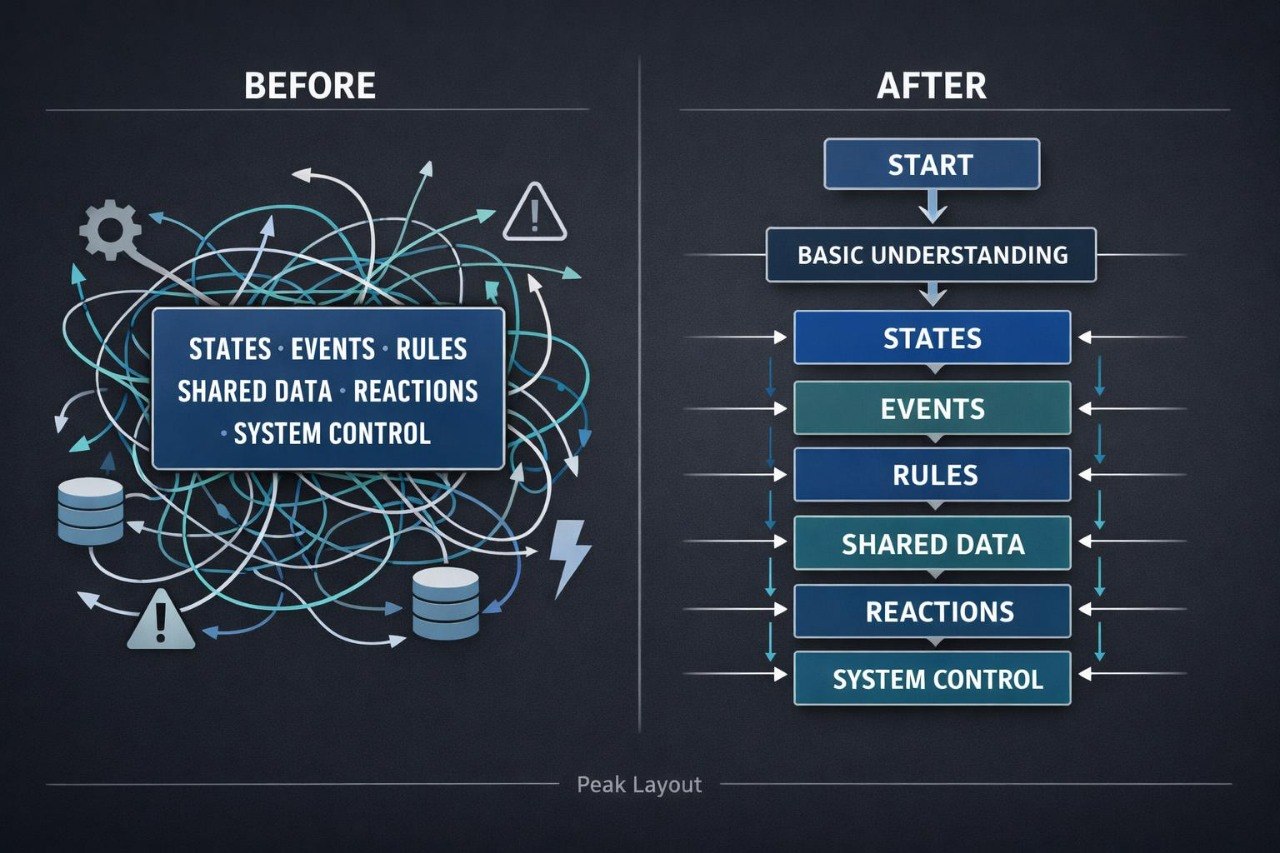
Struggling to connect several game mechanics when a change in one component affects the entire system? You’re not alone: as the number of rules, states, and dependencies grows, the logic structure may become difficult to follow. An event from one module can activate unwanted reactions in another, while shared variables create hidden connections. A small rule adjustment may then require the review of many related scenarios. Without an architecture map, it is difficult to determine where information should be stored and which component should handle each decision.
2. Solution
This course will teach you how to divide a detailed game system into connected logic components. You will explore architecture layers, module boundaries, event channels, and data-sharing rules. The materials demonstrate how to reduce direct dependencies and document communication between mechanics. Practical assignments help you examine the effects of a change before it influences other areas of the system. By the end of the course, you will create an architecture model containing several modules connected through defined rules and data flows.
3. What’s Inside
Module 1: Game Logic Architecture
Examine game logic as a system made of separate layers and components. This module explains how to separate control rules, object states, events, data, and reactions.
Module 2: Component Boundaries
Define the responsibility of each logic component. The practical exercise asks you to divide a large mechanic into at least six separate modules.
Module 3: Communication Between Systems
Explore how components can exchange events and values without creating too many direct connections. You will prepare a table of incoming and outgoing signals for each module.
Module 4: Shared Data Rules
Study information used by several systems. You will define the source of each value, its update rules, and the components permitted to read or modify it.
Module 5: Dependency Mapping
Build a dependency map and identify components that are too closely connected. The exercise helps replace selected direct dependencies with clearly documented events and conditions.
Module 6: Change Impact Analysis
Learn how to determine which scenarios should be reviewed after a rule, state, or data structure is changed. This module contains exercises that examine the effects of changes across several connected mechanics.
Module 7: Peak Layout Architecture Project
Create an architecture map for a detailed game system. The final project includes modules, data flows, event connections, a responsibility table, and a collection of interaction-review scenarios.
4. Who Is This For?
✅ Suitable if you:
- already work with states, events, variables, and dependencies;
- want to combine several mechanics into one coordinated system;
- want to define clear responsibilities for separate components;
- would like to examine how changes affect connected rules;
- are prepared to create architecture maps and technical tables.
❌ Not for you if you:
- are beginning to study game logic;
- need a brief introduction to basic concepts;
- do not plan to work with detailed diagrams;
- expect materials centered on a named program;
- do not want to complete a final architecture project.
5. What You’ll Learn
After completing Peak Layout, you will be able to:
- divide a large system into at least six logic modules;
- define the responsibility of each component;
- create a table of incoming and outgoing signals;
- document at least twenty connections between mechanics;
- build a shared-data map with update rules;
- identify at least three unnecessary dependencies;
- prepare a review plan for a system-rule change;
- create at least fifteen interaction scenarios;
- document a complete game logic architecture model.
6. Refund Terms
A refund request for Peak Layout may be submitted within 30 calendar days of the order date. Each request is reviewed according to the published store policy, the amount of material already completed, and the terms connected to the relevant order.
7. Certificate
Learners receive a digital Mekavelle certificate after completing the required modules, practical exercises, and final architecture project. The certificate records completion of Peak Layout: Game Logic Architecture.
1. Which experience levels are Mekavelle courses created for?
1. Which experience levels are Mekavelle courses created for?
The courses are structured for different levels of prior experience. Each plan has its own material depth, number of modules, and practical assignments, allowing learners to select a format that matches their current knowledge and learning goals.
2. How are the learning materials organized?
2. How are the learning materials organized?
The materials are divided into sequential modules with explanations, diagrams, examples, exercises, and final assignments. This structure helps learners gradually explore rules, states, events, conditions, and interactions within game systems.
3. Can I study at my own pace?
3. Can I study at my own pace?
Yes. Learners can organize their own study schedule and return to previous topics when revision is needed. Completing the modules in order is recommended because later topics build on concepts introduced earlier.
4. Is a certificate included?
4. Is a certificate included?
A digital certificate is included with plans that contain a complete learning path. It is issued after the learner completes the required modules and final assignment listed in the relevant course outline.
Share